
7 Signs Your CRM is Quietly Holding Your Business Back6 min read
Most CRM failures don’t look like failures. Nobody sends an email announcing that the system is no longer fit for purpose; it is something that happens gradually over time.
When employees start to keep their own spreadsheets and begin questioning the validity of the data they are basing their decisions on, they will start to create workarounds. These workarounds often create more problems, and before long the CRM becomes a place where information goes to die rather than a system that helps people make decisions.
The irony is that most organisations don’t have a CRM software problem. They have a CRM health problem. The good news? The warning signs are usually easy to spot if you know where to look. We’ve put together seven questions that will quickly reveal whether your CRM is helping your business move forward or quietly dragging it backwards.
1. Do People use the CRM Because They Want to, or Because They Have To?
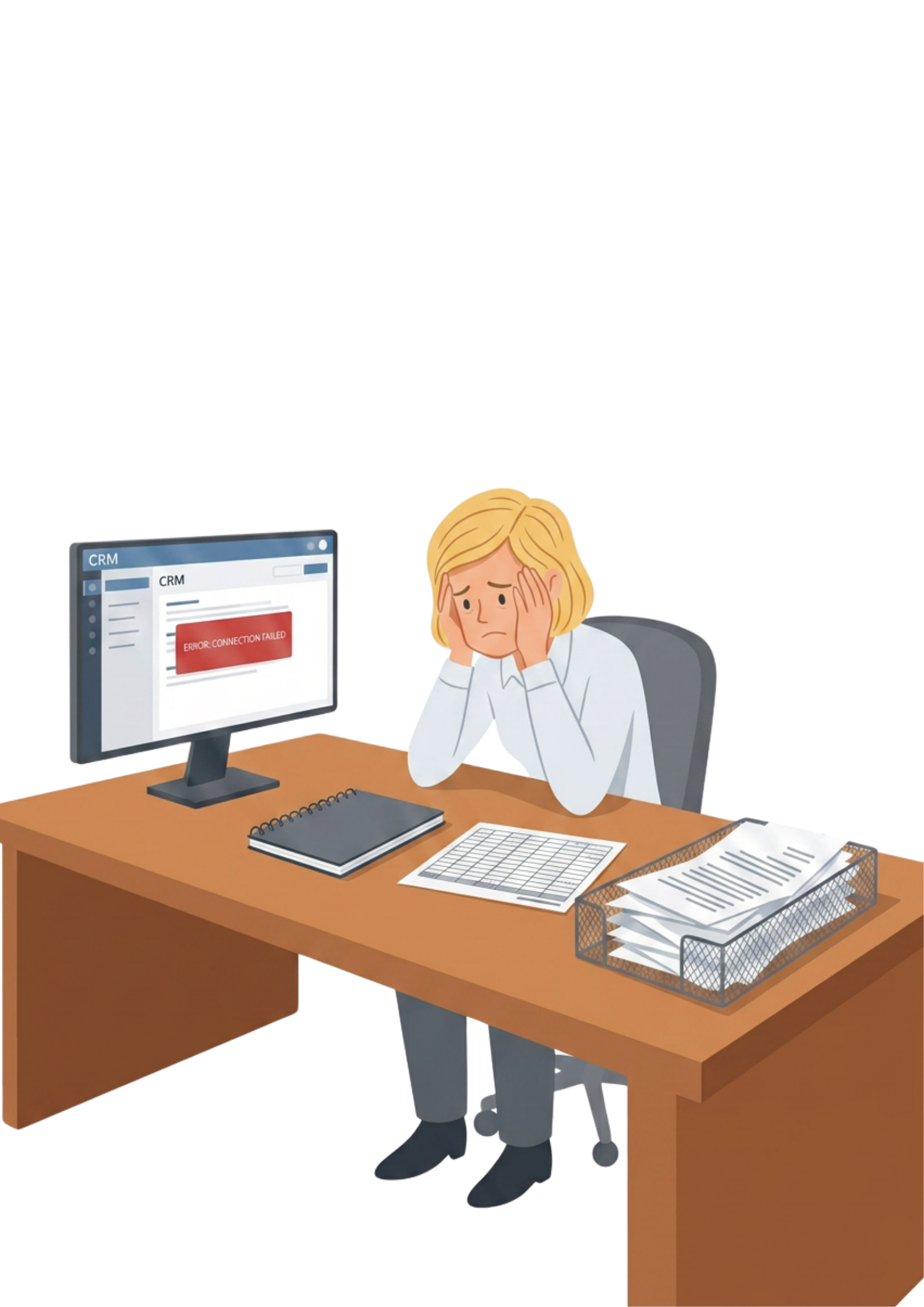
This is often the first crack in the foundations. Every organisation believes people are using the CRM until they start looking more closely. When customer notes are hidden in notebooks, opportunities exist in spreadsheets, and key conversations are buried in notebooks, the CRM is no longer supporting the business.
Ask yourself: if the CRM disappeared tomorrow, would your team struggle to do their jobs? In a healthy organisation, the answer is yes.
The best CRM systems become part of the way people work. Teams rely on them because they make life easier, not because management insists information is entered before the weekly sales meeting. When people only update records at the last minute, they’re not really using the CRM, they’re just feeding it, and once that behaviour starts, everything else begins to suffer.
2. Would you bet Next Month’s Forecast on the Quality of Your Data?
It’s a simple question but it’s incredibly revealing. Most businesses know they have some duplicates and there are missing fields somewhere. The real question is whether those issues have reached the point where people have stopped trusting the data entirely.
Poor CRM data creates a strange culture. Nobody fully believes the reports, but everyone continues using them. Without confidence, even the most sophisticated CRM becomes little more than an expensive filing cabinet.
Many CRM transformation projects begin with data cleansing for exactly this reason. Organisations often discover years of duplicate records, inconsistent formats, and legacy information accumulated through manual imports and disconnected processes. Without healthy data your CRM’s value will be held back.
3. Do Your Reports Answer Questions or Start Arguments?

Every CRM promises visibility, but not every CRM delivers it. One of the clearest signs of an unhealthy system is when meetings become debates about data rather than discussions about what to do next.
The sales report says one thing. Marketing has a different number. Finance has another version altogether. Eventually someone exports everything into Excel and spends half a day manually reconciling the figures. At that point, the CRM has become a source of uncertainty. A healthy CRM should make decisions easier. Leaders should be able to open a dashboard and feel confident they’re looking at a version of reality everyone accepts. When trust disappears, so does the value of reporting.
4. Is Your Pipeline a Genuine Picture of Customer Progress or a Collection of Hopeful Guesses?
Every company has opportunities that seem to live forever. Pipeline stages should reflect real movement and represent meaningful progress in a buyer’s journey, not internal optimism. If opportunities regularly sit untouched for months, close dates keep moving into the future, or stage definitions mean different things to different people, your pipeline may be creating an illusion of control rather than providing visibility.
5. Are Your Systems Talking to Each Other, or are Your People Acting as the Integration Layer?

This is one of the most expensive problems organisations rarely notice, because it costs time rather than money. Someone copies information from one platform into another. Customer updates are entered twice. Marketing data sits in one system while sales data sits somewhere else. Staff spend hours doing work that should happen automatically. Eventually these manual processes become accepted as “just the way things work”.
Modern CRM systems are supposed to reduce friction. They should bring information together, provide a complete customer picture, and eliminate repetitive administration. The challenge is common enough that many CRM replacement projects identify disconnected systems and limited integrations as major barriers to growth.
6. Who is Responsible for Keeping the CRM Valuable?
This question usually creates an awkward silence. During implementation, everyone knows who owns the project. After go-live, ownership often becomes less clear. The CRM gradually drifts away from how the business actually operates. Successful organisations treat CRM as an ongoing programme rather than a completed project. They invest in adoption, optimisation, governance and support because they understand that business requirements never stand still.
The most successful Cloud9 clients typically focus on continuous improvement, user adoption, reporting alignment, and optimisation long after implementation has finished.
7. Has Your CRM Actually Improved the Business?
This is the question that matters more than all the others combined.
Can you forecast with greater confidence? Are teams more productive? Do customers receive a better experience? Can leadership make decisions faster? Is revenue easier to predict?
If the answer is unclear, it may be time to step back and look beyond the technology itself. The purpose of a CRM is to create a clearer view of your customers and turn information into better business decisions.
Final Thoughts
The healthiest CRM systems rarely have the most features. They have the highest levels of trust. That’s what separates a CRM that creates value from one that creates admin.
The most successful CRM projects are defined by how well the system supports the people who use it every day.
We believe a CRM should fit around your business, your processes and your people, not force your teams into ways of working that don’t make sense. Whether you’re struggling with adoption, data quality, reporting, integrations or simply getting the value you expected from your investment, the first step is understanding where the challenges really sit.
If you suspect your CRM could be working harder for your business, we’d love to help. Contact Cloud9 at sales@cloud9insight.com.
Share On Social Media




Join Our Mailing List
Get the latest Dynamics 365 news, blog updates, webinars events and invitations.